
Paul Frees: You've Heard Him, Do You Know Him?
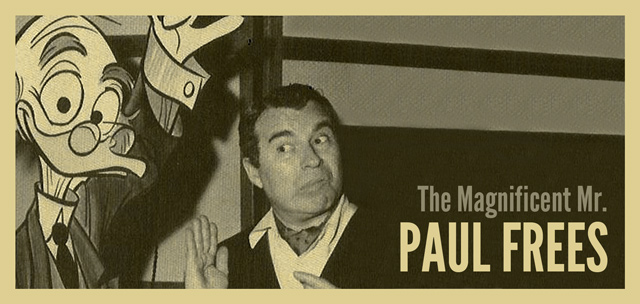


Paul Frees is one of those talents that is great fun to investigate. Even a short search of Paul Frees will have you saying "Really, that was him?"

Frees was born in Chicago and started his acting/radio career in 1942. Like so many, he was interrupted by WWII. Frees was drafted and fought in Normandy during the D-Day Invasion. After being wounded in action he attended college, but cut his education short when his wife became ill. Returning to radio, his versatile voice talents were put to work announcing and sometimes starring on Suspense. These duties were shared with his friend and fellow talented Voice, William Conrad. Frees explained in an interview that he would announce when  Conrad was starring in the episode, or involved with another project, and vice versa.  Both possessing memorable basso profundo voices, they made an effort to sound like one another in the announcements. Frees also did a lot of work on sister program Escape.

Paul Frees as Professor Ludwidg von Drake
Eventually Paul Frees voice would be everywhere. Other voice actors would stay with one studio, but Frees would work for as many as nine of the big animation studios in Hollywood, including Walter Lantz Studios, Rankin and Bass, Hanna-Barbera, MGM, DePatie-Freleng, and Disney. Frees would be awarded posthumously with a Disney Legend Award; Frees' role at Disney compared with Mel Blanc's at Warner Brothers, as an in-house "Man of a Thousand Voices."

Some of Frees' memorable characters include Profesor Ludwig von Drake, Donald Duck's uncle; Boris Badenov, from Rocky and Bullwinkle; The Little Green Sprout, companion to canned food spokes giant, Jolly Green; Santa Claus and the Cop in Frosty the Snowman; Burgermeister Meisterburger and Grimsby in Santa Clause is Coming to Town; Poppin' Fresh, the original Pillsbur Doughboy; as well as narrating many of the Wonderful World of Disney programs. Frees gave voice to a number of Disneyland's Animatronic features, such as the Abraham Lincoln exhibit, the Auctioneer in "The Pirates of the Caribbean", and the Ghost Host in "The Haunted Mansion." When asked if he resented the relative anonymity of his roles, he would explain "Sometimes, yes. But it's nothing I can't overcome when I look at the bank balance."

From 1948 through 1952 CBS tried to find a starring vehicle on radio for this great talent. In The Player and Studio X (1948), Frees played all of the scripted parts. The Green Lama (1949) was a typical costumed crime fighter whose super-powers were based on Tibetan Buddhism; Frees had the title role. As Reporter Larry Mitchell, he solved crimes in his own way in Crime Correspondent (1949). The Man in Black (1951) and The Black Book (1952) featured Frees as "The Teller of Tales," who presented stories from the dark side.  Paul Frees remained active until his death in 1986.

See the extensive Paul Frees old time radio show collection for additional recordings.

Comments

Popular posts from this blog

Candy Matson Old Time Radio Show

Candy Matson  was no GIRL detective...she was all woman. Candy Matson was a response to all the hard-boiled detectives on the radio like  Jeff Regan ,  Rocky Fortune ,  Pat Novak , and all those  other detectives  who were beaten up on a regular basis. Candy, played by Natalie Parks, was  hard-boiled  in her own way. She never compromised her femininity but she did know how to use a gun and didn't hesitate to use when it was necessary. She didn't take any guff from the guys--the good guys or the bad guys. With a snappy comeback, she could take anybody's head off. Candy was fearless, never hesitating to go wherever she needed to solve a case from the lowest dive to the classiest night club. Candy worked hard to get her goon. Men orbited around her like she was the sun. Her best friend and partner in detection was Rembrandt Watson, a flamboyant photographer. All private detectives need a police detective foil and, in...

Old Time Radio: Spies and Espionage

Old time radio featured many spy-themed shows , which were popular during the Cold War era . These shows often depicted heroic spies and agents who worked to protect their countries from enemy spies and espionage, adding to the cultural fascination with the world of espionage and intrigue during this time. Spy shows were popular in the 1950s for several reasons. Firstly, the Cold War was in full swing , and the fear of Soviet espionage and infiltration was widespread. As a result, there was a heightened interest in stories and characters that dealt with the world of espionage and intrigue. Spy shows offered a way for listeners to vicariously experience the world of espionage and feel a sense of excitement and danger. Additionally, radio was one of the primary sources of entertainment during this time, and spy shows offered a way for audiences to escape the anxieties of everyday life and engage with exciting stories and characters. Many of these shows also featured strong, heroic prot...

A Clown Laughs and Cries: Red Skelton

  The Clown is one of the most traditional and enduring elements of show business. There are several vital characteristics which add up to define just what a clown is. One of the most important is that under the makeup, the clown is very often laughing on the outside while crying on the inside. America's favorite clown, Red Skelton typifies laughing and crying at the same time. Few performers have given as much to bring happiness to their audience, especially while living through their own personal tragedies. Joe Skelton had performed as a clown with the Hagenbeck-Wallace Circus, but settled down to life as a grocer, and sired four sons with his wife Ida Mae. Joe was taken from his family two months before his youngest son, Richard Bernard Skelton, was born in 1913 (the same year, the Hagenbeck-Wallace Circus lost 8 elephants, 8 performing horses and 21 lions and tigers when the Wabash River flooded). Richard soon became Red Skelton . With no father, Red went to work early to hel...